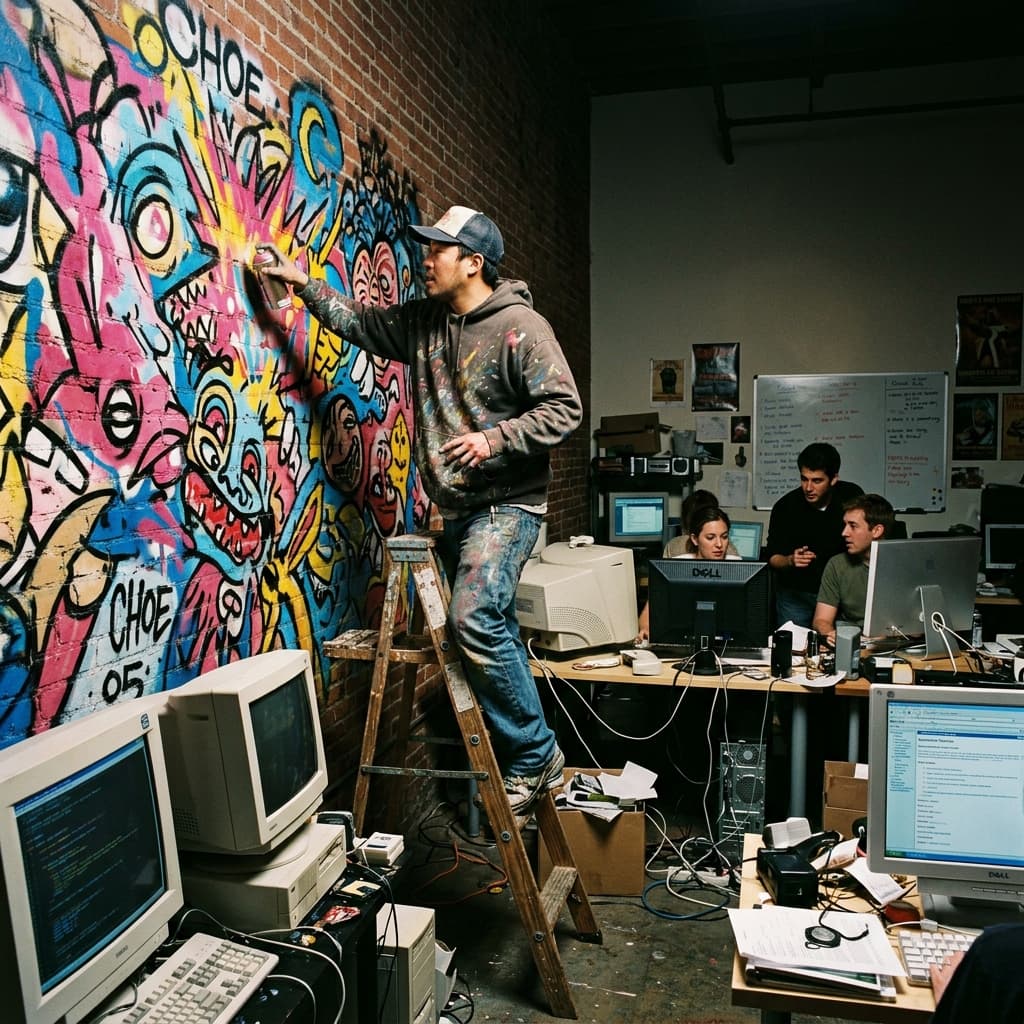
In 2005, a graffiti artist named David Choe was asked to paint the walls of a small tech startup's first office in Palo Alto.
The startup's president, Sean Parker, offered Choe a choice. He could take $60,000 in cash, or he could take company stock.
Choe thought the startup's business model seemed pointless. He didn't understand the hype. But he took the stock anyway. He figured the cash would just vanish, but the stock — no matter how unlikely — represented upside. That small startup was Facebook.
He Never Painted Another Office
Seven years later, on May 18, 2012, Facebook went public.
David Choe, the graffiti artist who had simply shown up to paint a wall, saw his stock valuation skyrocket. When the dust settled, his shares were worth an estimated $200 million.
Not because he was a tech genius. Not because he had a trust fund or a Wall Street background. But because he positioned himself inside a generational technology company right before its hyper-growth phase.
The biggest technology wealth creation events are almost never captured by everyday investors, simply because they aren't positioned before the window closes.
It is a story that has played out repeatedly over the last few decades: the people who get positioned in era-defining companies before they go public capture the lion's share of the wealth. After the IPO, it's mostly index funds and institutional money trading single-digit percentages.
The pattern is consistent. But the access for regular people has typically been blocked.
Until now.
The S-1 Filing and the $2 Trillion Mega-IPO
SpaceX is expected to go public this summer in what could be the largest IPO in history, combining its rocket launch monopoly, the Starlink satellite internet constellation, and xAI — the artificial intelligence company it merged with in early 2026.
Bloomberg reports the S-1 paperwork could come at any time. Initial estimates suggest a target valuation exceeding $2 trillion.
The momentum heading into this filing is staggering. SpaceX launched more mass to orbit last year than every other nation on Earth combined, completely dominating the global space economy. Starlink revenue grew from $1.4 billion to over $6.6 billion in just two years. And with the recent xAI merger, SpaceX is building a constellation of orbital AI supercomputers — effectively cornering the market on space-based compute power.
SpaceX is no longer just a rocket company. It's the foundational infrastructure company for the next century.
You Don't Need to Paint Their Office to Get In
During the Facebook era, the only way David Choe could get a piece of the upside was by being inside the building.
During every massive IPO in history, ordinary investors were locked out. Wall Street underwriters and institutional players captured the gains, while everyday families were forced to buy in on the public market after the biggest moves had already happened.
That is no longer the case. You don't need a six-figure brokerage account. You don't need to be an accredited investor. And you certainly don't need to paint anyone's office.
Jeff Brown, a former senior technology executive at Qualcomm, NXP Semiconductors, and Juniper Networks, has been tracking this exact scenario for years. He flagged Nvidia before its AI breakout and recommended Tesla before it hit $1 trillion.
Brown recently published a free video presentation detailing his research on the SpaceX IPO. He shows how everyday Americans can get exposure before the offering — as simple as buying any other stock, starting with as little as $500, from a regular brokerage account.
All investments carry risk, and positions taken before a public offering are less liquid than publicly traded stocks. No investment is guaranteed.
But the access that didn't exist before is real — and the window is narrowing. Once the S-1 goes public and the Wall Street machine formally kicks into gear, the biggest gains window closes.
Brown publishes his ongoing research through The Near Future Report.