For the first time, SpaceX is earning more from AI than from Starlink.
In its third-quarter results on October 20, SpaceX reported $7.6 billion of revenue from its AI business, which it calls Super Intelligence, against $5.2 billion from Starlink. It put 84% of the quarter’s capital spending into AI.
Elon Musk has said where he thinks AI will be cheapest to run:
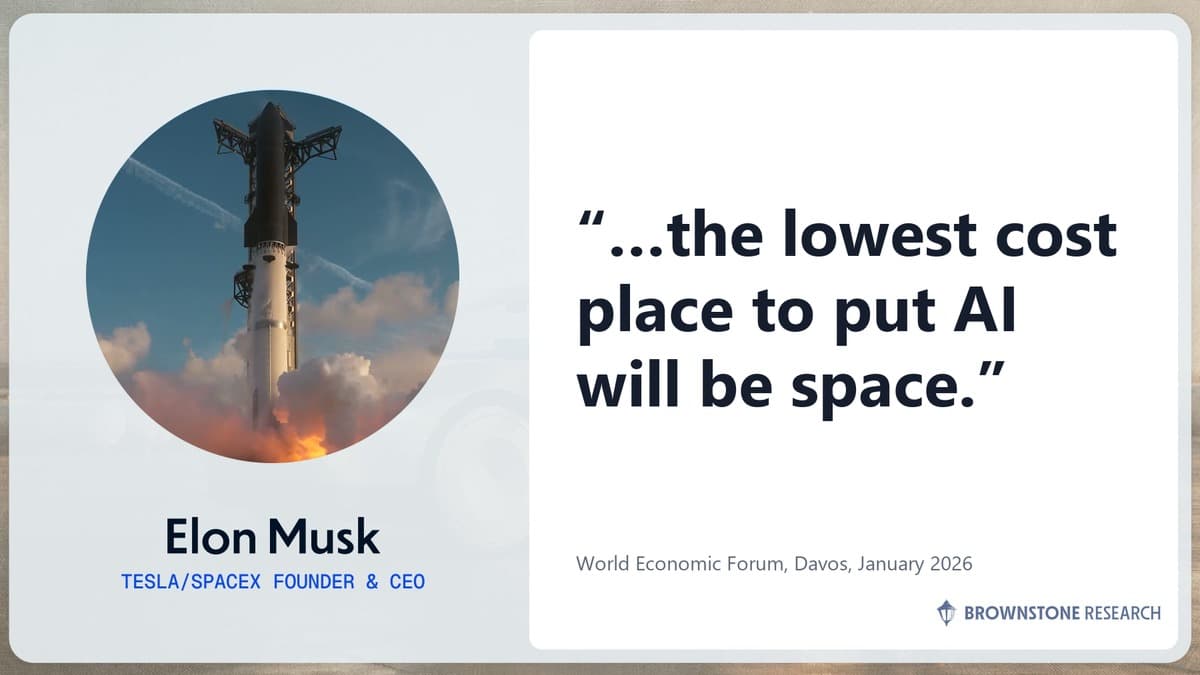
He told the World Economic Forum in January that it “will be true within two to three years, three at the latest.”
It sounds like science fiction. Jeff Brown has heard that before.
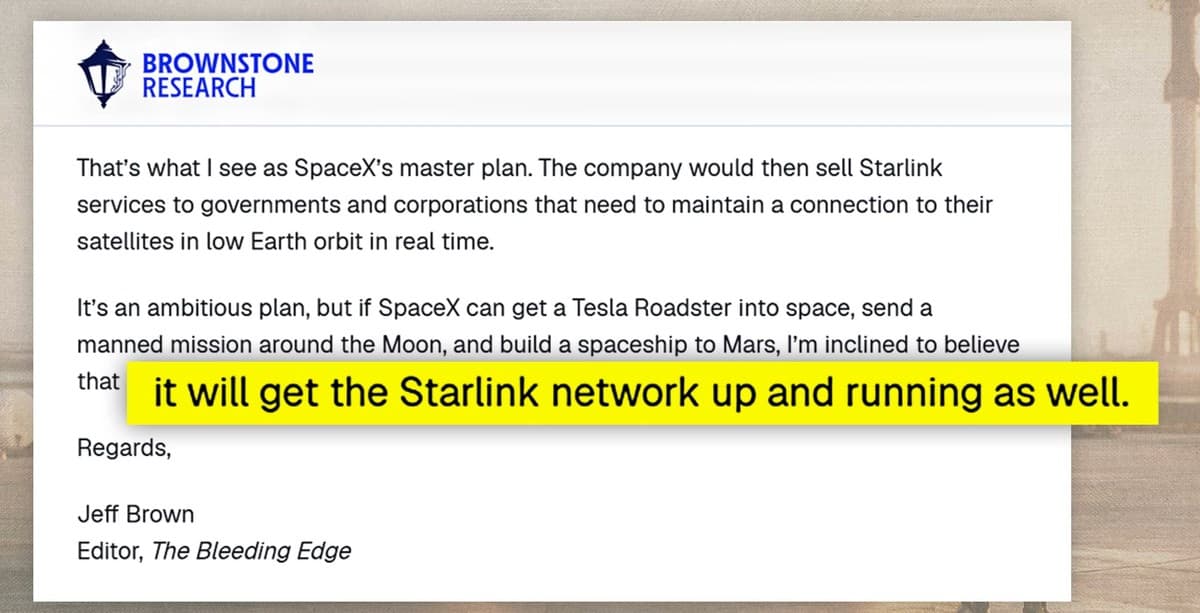
In 2019, while parts of the media called Starlink a “pipe dream,” Jeff predicted it would get up and running and start selling its service. A year later, he says, it did. Starlink now has 13.6 million consumer subscribers.
Why Run AI in Space?
Jeff says electricity has become the AI industry’s biggest bottleneck. A single data center can use as much power as 100,000 households or more, and new power plants can take years to build.
Elon’s answer, as Jeff explains it, is to pack satellites with AI chips and send them to orbit, where the sun can power them around the clock. There are no clouds in space. And it’s so cold that the satellites can shed extra heat through radiators. No fans. No water.
SpaceX has asked the FCC for permission to launch up to one million satellites as orbital data centers. Jeff says that would be about 100 times the size of Starlink today.
And he says no one can compete with SpaceX’s reusable rockets, which he says have made it about 20 times cheaper to put things in orbit. He expects Starship, which he calls the biggest and most powerful rocket in history, to cut the cost another tenfold. In September, Starship reached orbit for the first time and released 26 of SpaceX’s newest Starlink satellites.
The “Space Chip”
Jeff says every one of those satellites will need a special “space chip” that can convert, regulate and distribute electricity in one of the harshest environments there is.
He believes he’s found the company that makes it. And he says it already works with SpaceX: for more than a decade, on chips used in every Starlink satellite and ground terminal. He calls it a “backdoor way” to potentially profit from Elon’s AI satellite plan.
His Record and His Next Call
Jeff spent more than two decades as a senior executive at Qualcomm, NXP Semiconductors and Juniper Networks. He says his background helped him pick Nvidia before it jumped as high as 37,800%, and Tesla before it jumped almost 2,200%.
Selected peak figures, not typical results or subscriber returns. Past performance does not guarantee future results.
“But I’m not here to recommend Tesla,” he says. He says the satellites are step two of Elon’s three-step AI plan, and he’s picked a little-known company for each step.
Step 1: Chips
Elon’s Terafab chip project. Jeff believes he’s found the company that will supply the chip-making machine it needs.
Step 2: Energy
Jeff says Elon plans to put AI chips on satellites, powered by the sun. His pick is a company he says has worked with SpaceX for more than a decade, on chips used in every Starlink satellite and ground terminal.
Step 3: Robots
Self-driving Cybercabs and Optimus, Tesla’s humanoid robot. His pick is a company he says already supplies Tesla with a key piece of sensor technology. He wouldn’t be surprised if it ends up supplying Optimus too.
The short version
- SpaceX now earns more from AI than from Starlink, and Musk says space will be the lowest-cost place to run AI.
- Jeff Brown, who predicted Starlink’s success in 2019, says Elon plans to run AI from solar-powered satellites.
- He’s picked a little-known company for each step of Elon’s plan, including one he says has worked with SpaceX for more than a decade.
Jeff’s free presentation lays out all three steps. The companies’ names come with a paid subscription to The Near Future Report, which renews automatically each year.
Free to watch · Investing involves risk · Elon Musk hasn’t endorsed Jeff’s research. The picks are Jeff’s.